You upload
- Colour, texture and motif read from the cloth
- Cut to salwar suit construction rules
- Photographed on your chosen model
You get
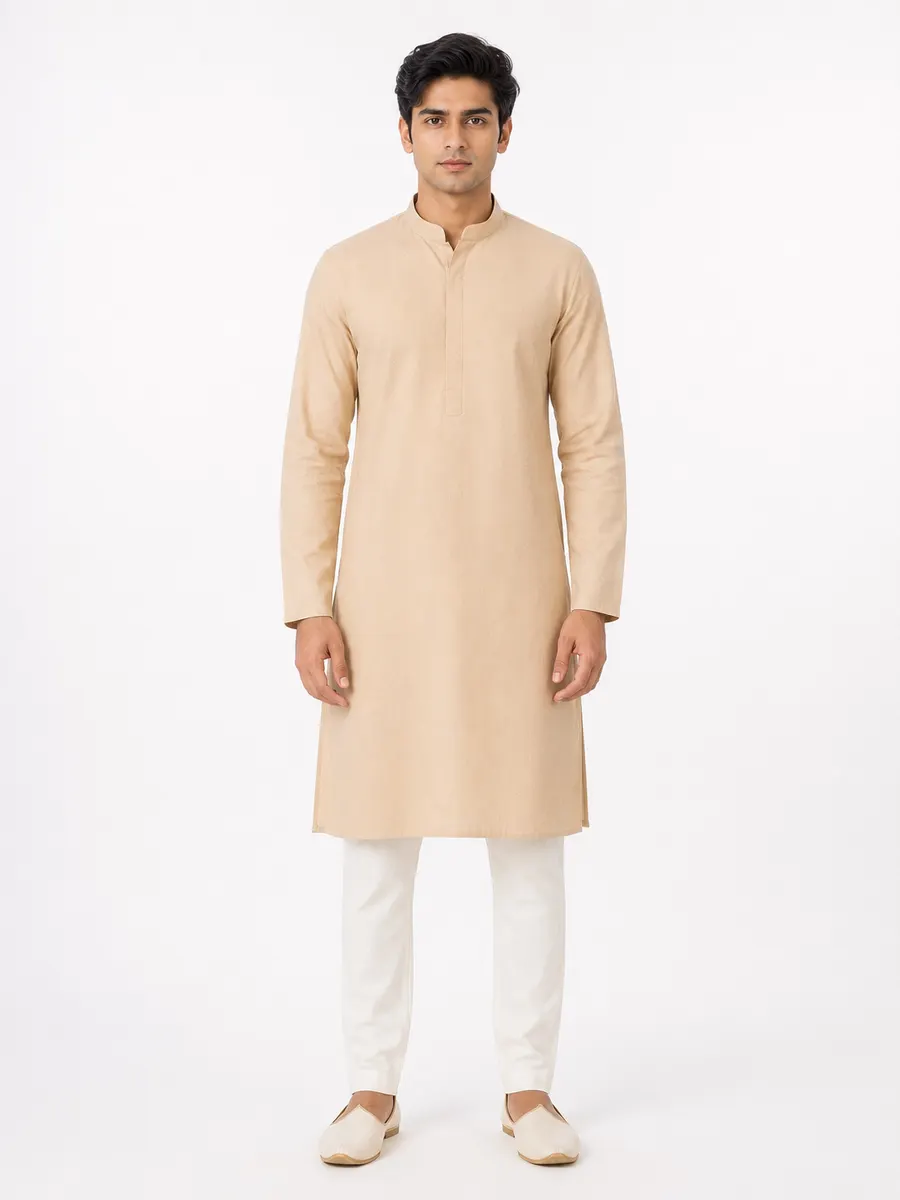
Example output. Generated figure, not a real person.
How does an AI generate a full salwar suit from one fabric?
A salwar suit is a three-piece outfit: a long kameez tunic, a fitted churidar bottom, and a dupatta. Sold as an unstitched suit length, it's usually one printed panel plus coordinating cloth — and the finished suit almost never puts the same busy print on all three pieces.
Vastram Studio generates it as a set. The kameez carries the supplied textile as the hero surface with the full motif field running down the body. The churidar takes a coordinated solid tone pulled from the textile's own palette, unless the reference is clearly a fine all-over print suited to a full bottom. The dupatta carries the same textile at lighter density with its border along the long edges. That allocation is what makes the generated photo look like a suit a tailor made rather than three garments in the same wallpaper.
The hard part
Where salwar suit photos usually go wrong
These are the failures a buyer notices before they notice anything else — and the reason a generic image tool isn't enough for garment work.
The churidar shouldn't repeat the kameez
Churidar gathers are a signature
The dupatta ties the set together
Construction
How Vastram Studio cuts a salwar suit
Like the lehenga, the salwar suit is a multi-piece garment with a per-component fabric allocation:
- The kameez with front and back panels, bust shaping, and a straight or gently A-line body reaching knee length or below.
- A designed neckline finished with a clean facing, and set-in sleeves.
- Side slits from the hip down, finished flat.
- A churidar bottom fitted through the leg, with the characteristic gathered folds stacking at the ankle.
- A dupatta as a long rectangular length with finished edges, carrying the textile at lighter density.
Where the detailing lands
- Border placement
- At the kameez hem and along the dupatta's long edges. The churidar stays plain apart from an optional narrow ankle detail.
- Motif handling
- The generator is instructed to hold motif scale constant between kameez and dupatta so the pieces read as a set, and to preserve the pattern's direction down the body.
- Drape
- The kameez falls straight from the bust in soft vertical folds; the dupatta drapes fluidly; the churidar gathers into fine horizontal folds at the ankle.
- Fit across sizes
- Both upper and lower ease rules apply — chest, waist and armhole for the kameez, waistband, seat, thigh and leg width for the bottom, each cut to the model's actual measurements.
Workflow
From cloth to salwar suit catalog in four steps
- 1
Upload one reference
If you're selling unstitched suit lengths, photograph the printed kameez panel flat with the border visible. Including the coordinating dupatta or bottom fabric in the same frame helps the generator pick a churidar tone that matches what you'd actually pair.
- 2
Choose salwar suit and a model
Pick the garment type, model type and body type, then a pose and a background from the studio library — or upload your own model, pose or background to reuse across the season.
- 3
Generate the set
Ask for several poses, backgrounds and colourways in one job. Images arrive as they finish rather than all at once, so you see the first result before the whole batch is done.
- 4
Brand, group and share
Add your logo, design number and rate, group the results into a catalog, export a PDF, or send a private lookbook link on WhatsApp.
Output
What a salwar suit shoot gives you
- Full-length catalog frames showing kameez, churidar and dupatta together.
- Front, side and back angles of the same suit for marketplace listings.
- Colour variants of the same suit design, useful when one cut sells in several shades.
- Branded frames carrying design number, colour and rate — the standard format for suit wholesale.
One credit, one photo
Every image costs one credit, and credits never expire. There is no subscription and no per-seat charge — see pricing for the current packs.
Every image is delivered in the shape you need
The same generated photo downloads as an Instagram feed crop, a story frame, a marketplace listing, a website or PDF image, or a square post — resized on the way out rather than cropped by hand.
Marketplace listing
3:4
Instagram feed
4:5
Story & WhatsApp
9:16
Website & PDF
2:3
Square post
1:1
More on choosing between them in the image-sizes guide.
Questions
Salwar suit photoshoot questions
I sell unstitched suit material. Does that work?
Can I get a palazzo or sharara instead of a churidar?
Can I put my design number and rate on the photo?
Your next salwar suit shoot starts with one photo of the cloth.
Sign up, upload a reference, and see the first result before you spend anything.
Create your salwar suit photoshoot2 free credits on signup. No card needed.
Keep reading
AI kurti photoshoot
Bust shaping, A-line release, hem and neckline borders.
OpenBranded catalog images
Logo, business name, price, design number and phone on every photo.
OpenFor manufacturers & wholesalers
Design numbers, MOQ, rate cards and buyer lookbooks at catalog scale.
OpenCatalog & PDF lookbook
Group designs into a catalog, export a PDF, share a private link.
Open